


If you are planning a flooring project in your New Jersey home, one of the first decisions you will face is whether to install solid hardwood or engineered hardwood. Both are real wood products. Both can look identical once installed. Both can last decades when properly maintained. But they are fundamentally different in how they are constructed, where they can be installed, how they respond to New Jersey’s climate, and how much they cost.
This guide breaks down every meaningful difference between solid and engineered hardwood for NJ homeowners — from moisture performance in our humid summers and cold winters, to cost comparisons, refinishing potential, resale value, and the specific situations where each product is the right choice. By the end, you will know exactly which option fits your home, your lifestyle, and your budget.
Floor Supreme has installed and refinished both solid and engineered hardwood floors for homeowners throughout Monmouth County, Ocean County, and Middlesex County for over 15 years. The recommendations in this guide are based on that real-world experience — not manufacturer marketing materials.
What Is Solid Hardwood Flooring?
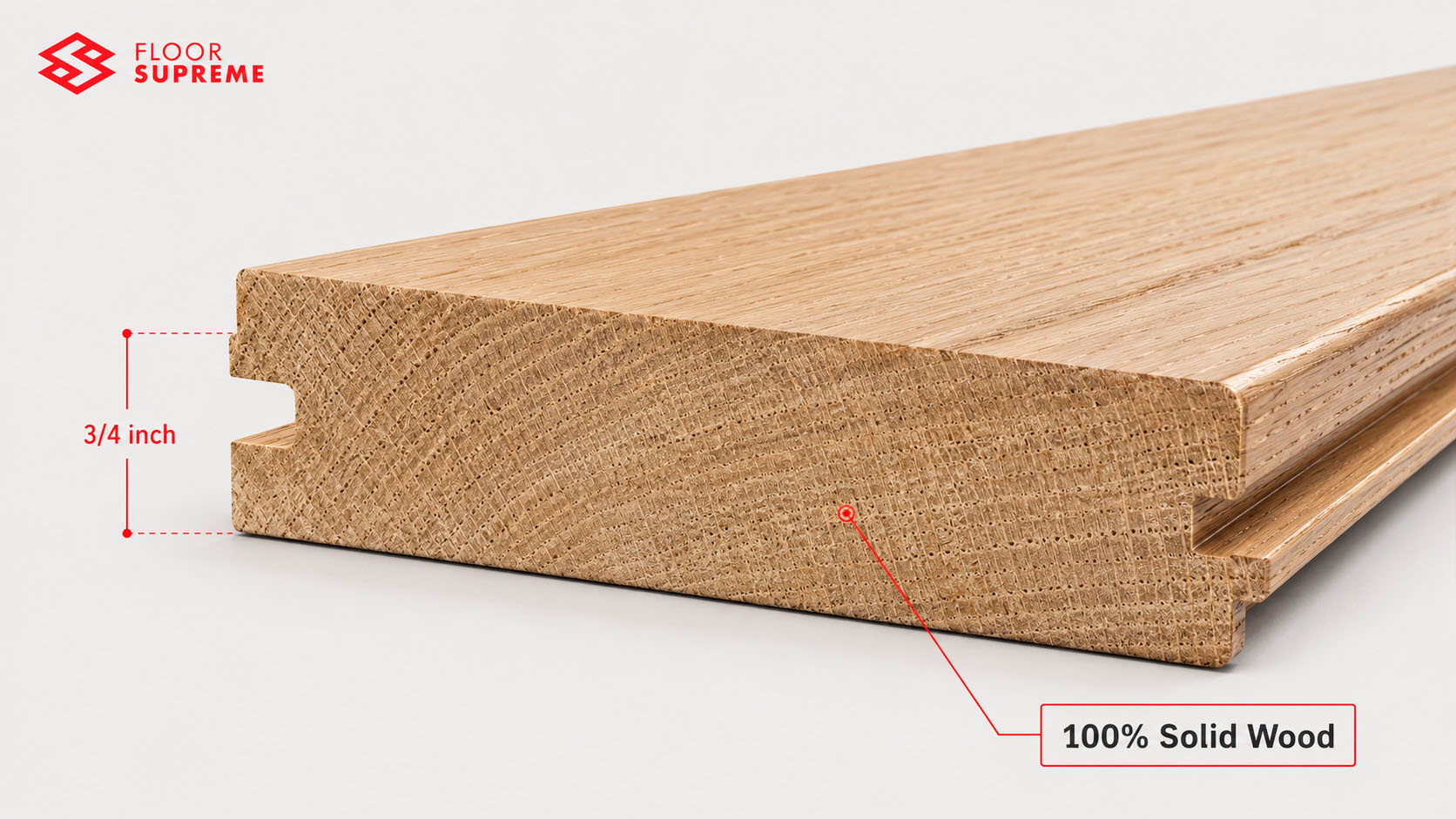
Solid hardwood flooring is exactly what it sounds like: a plank milled from a single, solid piece of wood from top to bottom. Standard residential solid hardwood is 3/4 inch thick and available in widths ranging from 2.25 inches (strip flooring) to 5 inches and above (wide plank). The entire plank — every millimeter from the surface to the underside — is the same species of wood.
Because solid hardwood is a solid piece of wood, it can be sanded and refinished repeatedly across its lifespan — typically 5 to 7 times for a 3/4 inch plank, depending on how aggressively each sanding removes material. This means a solid hardwood floor installed in your NJ home today could conceivably last 80 to 100 years with proper maintenance and periodic refinishing.
The trade-off for this longevity is moisture sensitivity. Wood is a hygroscopic material — it expands when it absorbs moisture from the air and contracts when it releases moisture. In a solid hardwood plank, this movement is significant and directional. When the indoor humidity swings dramatically between New Jersey’s humid summers and its dry forced-air-heated winters, solid hardwood floors will expand, contract, cup, gap, and sometimes squeak in response to those humidity changes. Managing this movement requires controlling indoor humidity within the 35–55% range year-round — a commitment that not every NJ homeowner is prepared for or equipped to make.
What Is Engineered Hardwood Flooring?
Engineered hardwood is a multi-layer product with a real wood veneer bonded to a core of high-density plywood or high-density fiberboard (HDF). The top layer — the visible surface — is the same real wood species as you would see in a solid hardwood product. The layers beneath it are cross-ply plywood or compressed wood fiber, oriented in alternating directions.
It is critical to understand that engineered hardwood is not a synthetic product. The surface you see and walk on is real wood — real oak, real walnut, real hickory. The difference from solid hardwood is entirely in the construction beneath the surface layer, and that construction difference is what makes engineered hardwood behave so differently in real-world conditions.
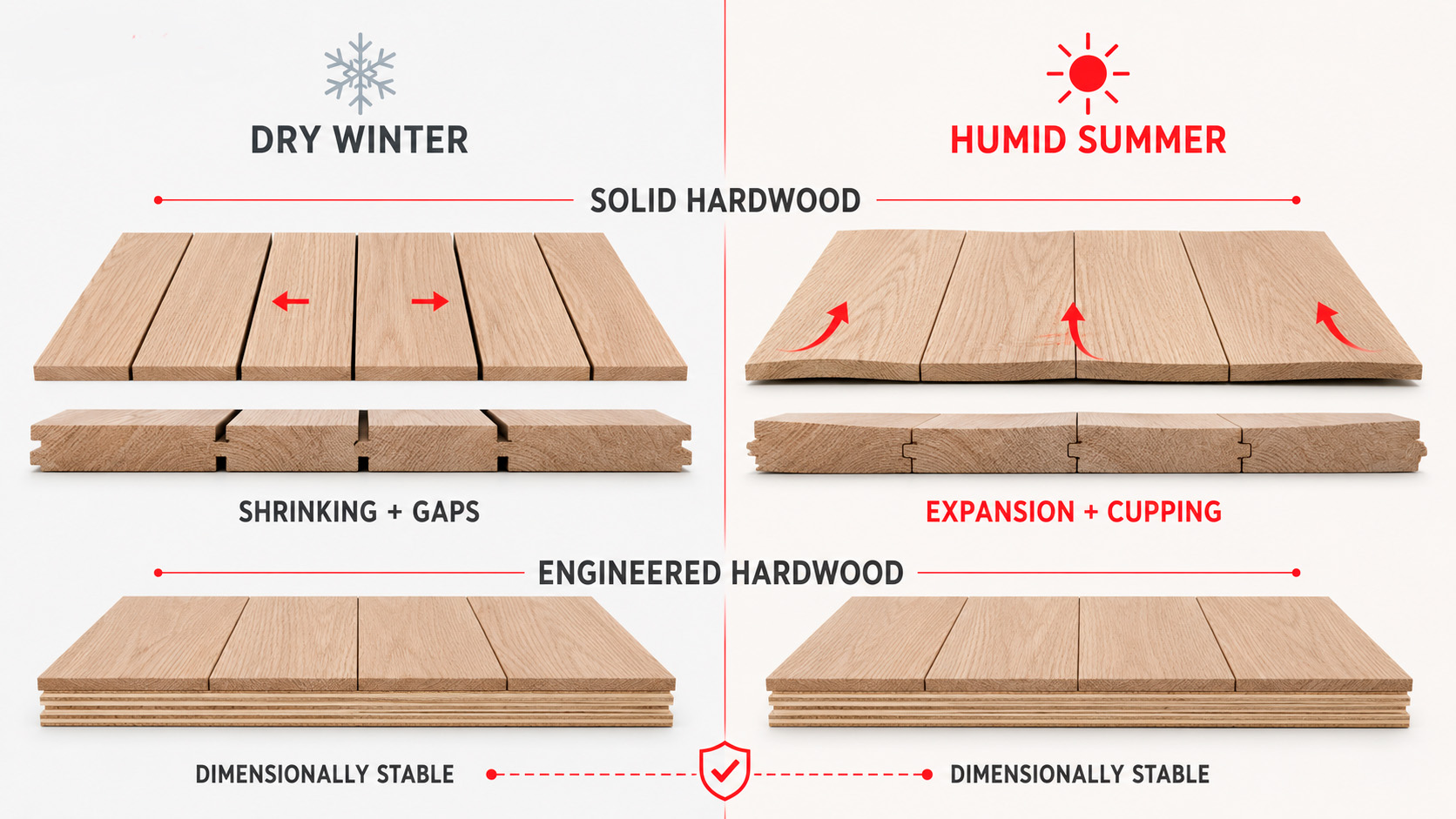
The cross-ply core construction of engineered hardwood counteracts the natural tendency of wood to expand and contract with humidity changes. Because the alternating plies resist each other’s movement, engineered hardwood is significantly more dimensionally stable than solid hardwood — particularly in environments with fluctuating humidity, such as NJ and NY homes that cycle between humid summers and dry heated winters.
Solid vs Engineered Hardwood: Key Differences for NJ Homeowners
1. Humidity and Moisture Performance — Critical in New Jersey
This is the most important comparison for New Jersey homeowners, and it is where the two products diverge most significantly. New Jersey’s climate creates some of the most challenging conditions for hardwood flooring in the continental United States: outdoor humidity that regularly exceeds 80% in summer, paired with forced-air heating systems in winter that can reduce indoor relative humidity below 20% without intervention. This seasonal swing — from extremely humid to extremely dry — creates significant stress on solid hardwood floors.
Solid hardwood floors in NJ homes that are not humidity-controlled will exhibit visible seasonal gapping between planks in winter (as the wood contracts in dry air), and potential cupping or crowning in summer (as the wood swells in humid conditions). These are not installation defects — they are the natural response of solid wood to humidity variation. They can be minimized or eliminated by maintaining indoor humidity within the 35–55% range year-round using whole-home humidifiers in winter and central air conditioning supplemented by dehumidifiers in summer.
Engineered hardwood performs significantly better than solid hardwood in NJ’s humidity conditions. Its cross-ply construction absorbs seasonal humidity changes with far less visible movement — planks stay tighter in winter and are less prone to cupping in summer. This makes engineered hardwood the lower-risk choice for NJ homes, particularly in spaces where humidity control is impractical (basements, kitchens) or where the homeowner is not prepared to invest in whole-home humidity management.
2. Where Each Can Be Installed in Your NJ Home
Installation location is the clearest practical differentiator between solid and engineered hardwood for NJ homeowners.
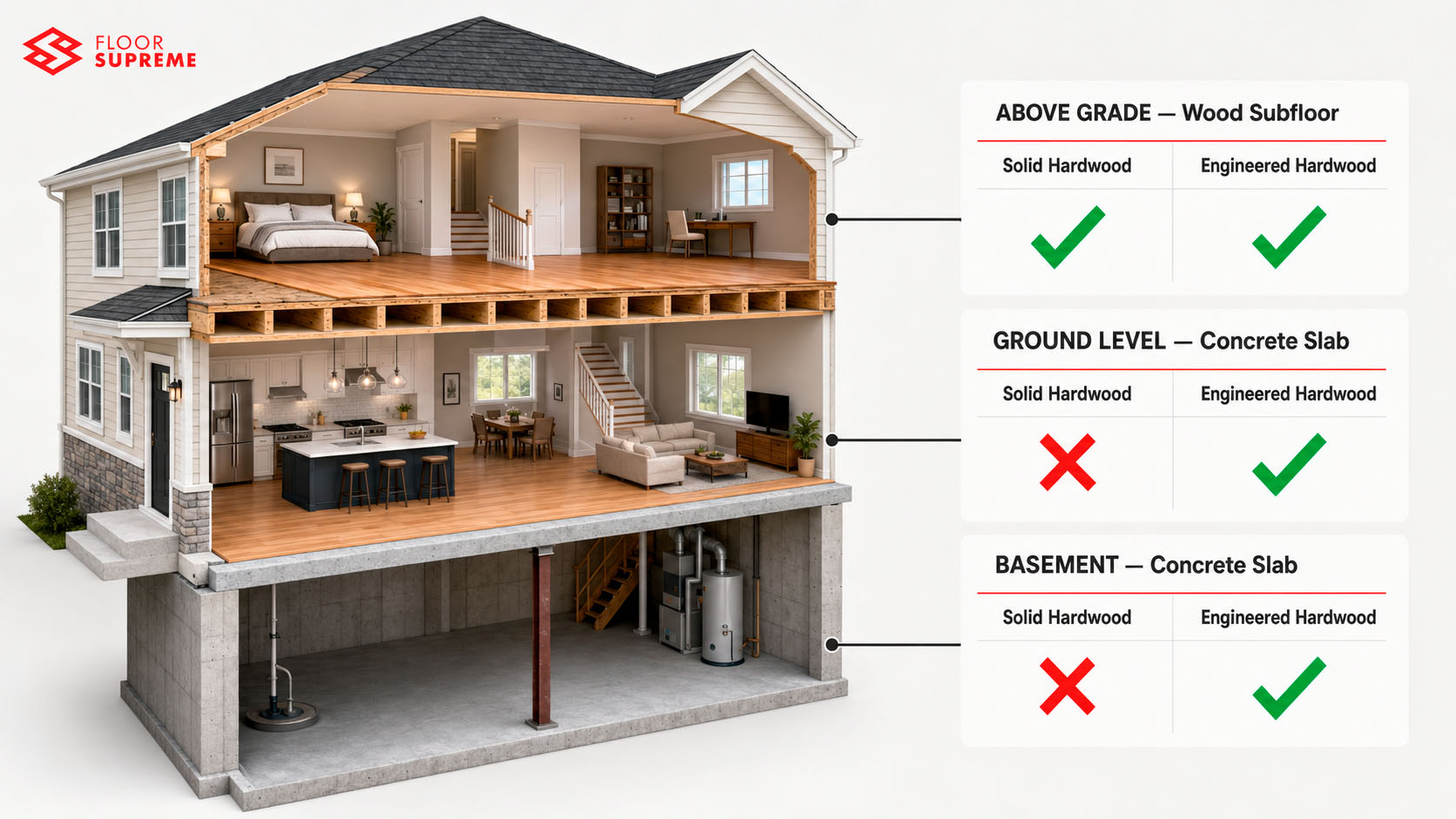
Solid hardwood can only be installed on or above grade — meaning on the main level, upper floors, or ground-level installations over a wood subfloor. It cannot be installed in NJ basements or directly over concrete slabs, because the moisture vapor that concrete slabs emit continuously would cause the solid wood to cup, warp, and eventually fail. Solid hardwood also requires nail-down or staple-down installation into a wood subfloor, which eliminates floating installation as an option.
Engineered hardwood can be installed on, above, and in some cases below grade. It can be glued down to a concrete slab, floated over a concrete subfloor with a vapor barrier, or nail/staple-down attached to a wood subfloor. This versatility makes engineered hardwood the only hardwood option for NJ homeowners looking to install real wood flooring in a finished basement — provided the basement’s moisture levels are controlled and remain consistently below 75% relative humidity.
3. Refinishing Potential
For many NJ homeowners, the ability to refresh and renew a hardwood floor through professional refinishing is one of the primary reasons to choose wood flooring in the first place. The two products differ significantly in their refinishing potential.
Solid hardwood at 3/4 inch thickness can be sanded and refinished 5 to 7 times across its lifespan. Each refinishing cycle removes a thin layer of wood — typically 1/32 to 1/16 inch — restoring the surface to like-new condition by removing scratches, wear, and the previous finish. This means a solid hardwood floor installed today can be refinished by a future homeowner, and by the next owner after that, across a century of occupancy.
Engineered hardwood refinishing potential depends entirely on the thickness of the top wood veneer (the wear layer). Engineered products with a wear layer of 3mm or thicker can typically be refinished 1 to 2 times. Products with wear layers of 1–2mm — which includes many entry-level engineered products — cannot be refinished at all without sanding through to the plywood core, making them a replace-don’t-refinish product when worn. When specifying engineered hardwood for a NJ home where refinishing potential matters, the wear layer thickness is the single most important specification to evaluate.
4. Cost Comparison in the NJ Market
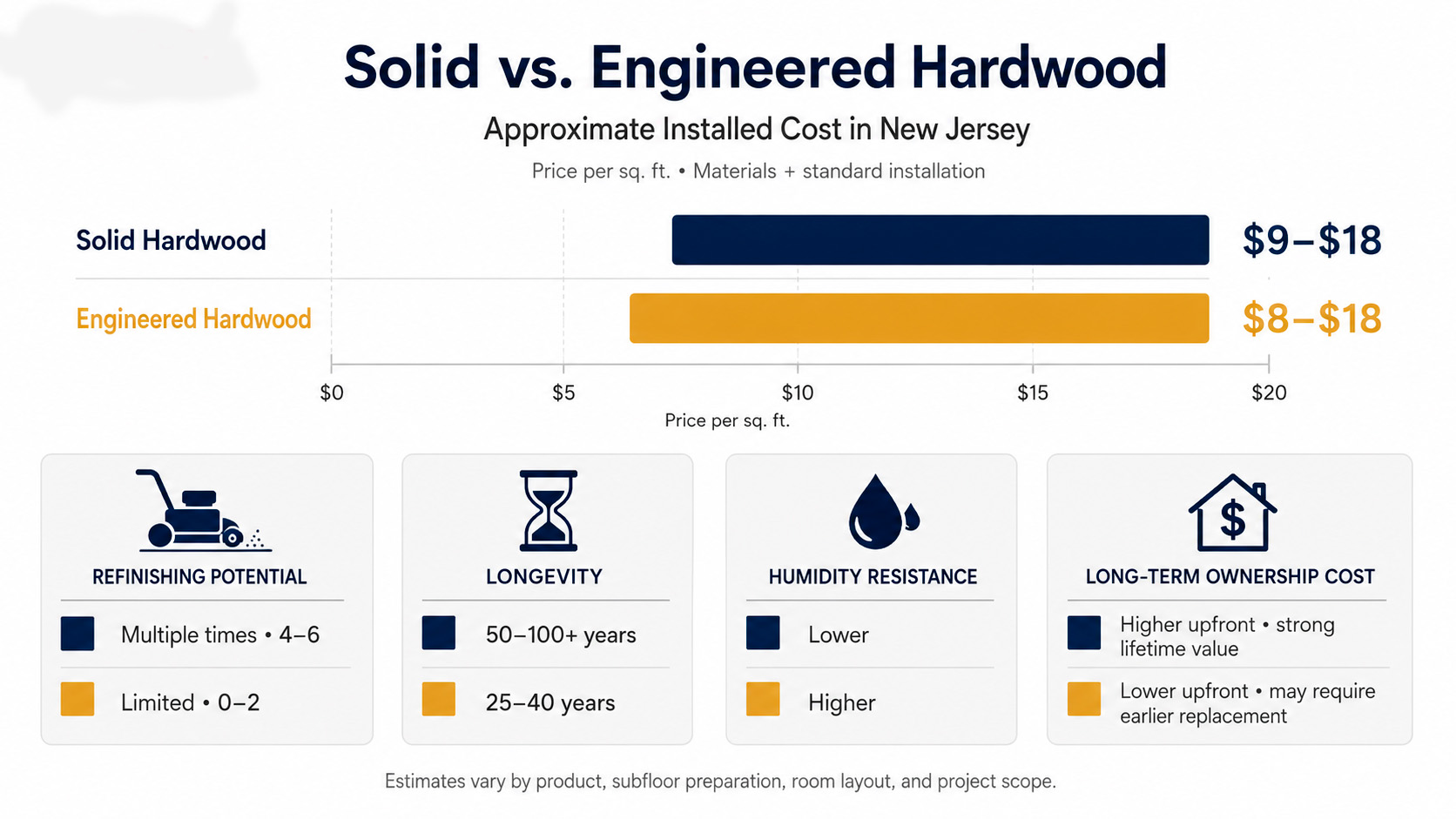
In the NJ and NY flooring market in 2026, solid and engineered hardwood occupy similar price ranges at the installed level, with solid hardwood carrying a modest premium at equivalent species and quality tiers. Solid red oak in standard widths installs for approximately $8 to $12 per square foot. Engineered red oak in comparable quality and width installs for approximately $7 to $11 per square foot. Wider plank formats push costs higher in both categories, with wide-plank white oak (5 inches and above) in solid or engineered format ranging from $12 to $20 or more per square foot installed depending on grade and finish specification.
The cost comparison between the two products should also account for long-term cost of ownership. Solid hardwood’s superior refinishing potential means it will cost less to refresh over a 30-year ownership horizon than engineered hardwood product with a thin wear layer that requires full replacement when worn. Conversely, engineered hardwood’s better performance in high-humidity environments reduces the risk of costly moisture-related failures that can require emergency repair or replacement in solid hardwood floors in NJ homes without adequate humidity control.
5. Appearance: Can You Tell the Difference?
In most cases, no. The top surface of an engineered hardwood plank is the same species of real wood as a solid hardwood plank — it has the same grain, the same texture, and accepts the same stains and finishes. Once installed and finished, a professionally installed engineered white oak floor is visually indistinguishable from a solid white oak floor to virtually any observer, including most flooring professionals looking from standing height.
The visible difference between solid and engineered hardwood, if any, is most likely to appear at the edge of a plank in a doorway or transition — where the cross-ply core layers of engineered hardwood can be seen if the edge is exposed. In a full installation where all plank edges are covered by adjacent planks or trim, this distinction is invisible.
6. Resale Value in New Jersey Real Estate
Both solid and engineered hardwood add meaningful resale value to NJ homes — significantly more than carpet, LVP, or laminate at equivalent quality tiers. In the NJ residential real estate market, “hardwood floors throughout” is one of the most consistent listing features cited by real estate agents as a selling point that accelerates sale timeline and supports asking price.
The distinction between solid and engineered hardwood is not typically visible to NJ homebuyers during a showing, and it is rarely disclosed in listing descriptions. From a resale perspective, the practical difference is minimal — provided the engineered product has a wear layer thick enough to be refinished before sale if the floors show wear. A refinished engineered hardwood floor supports the same resale value claim as a solid hardwood floor.
Solid vs Engineered Hardwood by Room — NJ Home Guide
Living Room and Dining Room
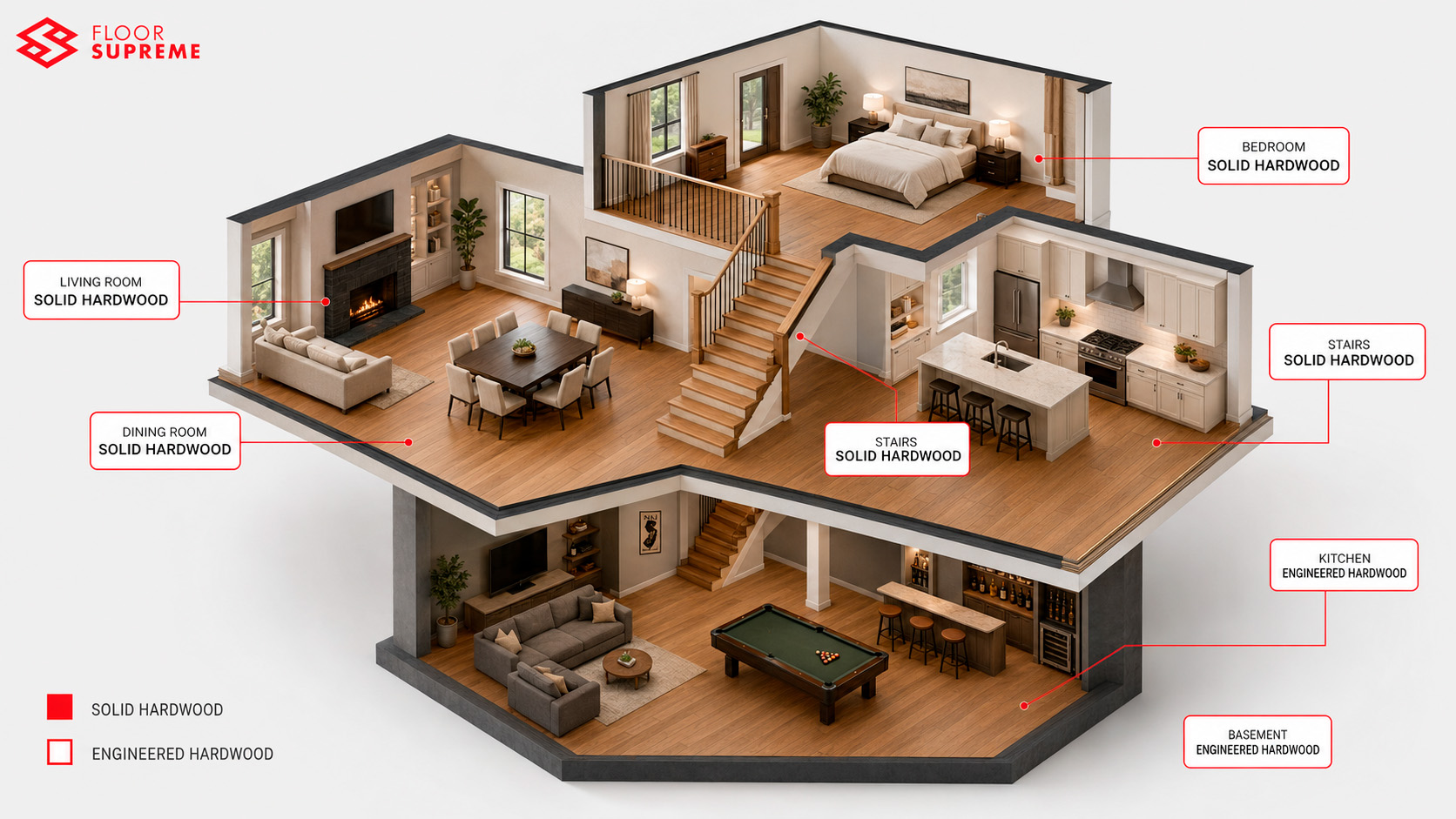
Both solid and engineered hardwood are appropriate for above-grade living and dining rooms in NJ homes with adequate humidity control. Solid hardwood is the higher long-term value choice in these spaces because its superior refinishing potential will allow it to be restored multiple times across a long ownership horizon. Engineered hardwood with a thick wear layer (3mm+) is the better choice for homeowners who do not have or are not willing to invest in whole-home humidity control.
Bedroom
Bedrooms are typically lower-moisture, lower-traffic spaces where solid hardwood performs well. Either product is appropriate; the choice comes down to budget, humidity control status of the home, and refinishing preference.
Kitchen
Engineered hardwood is the correct hardwood choice for NJ kitchens. The moisture exposure from cooking, sink use, and refrigerator condensation makes kitchens an inappropriate environment for solid hardwood, which is highly sensitive to concentrated moisture sources. Engineered hardwood in the kitchen remains the preference of NJ homeowners who want the warmth and character of real wood in a kitchen — it tolerates the moisture conditions better than solid hardwood, though it is not waterproof and spills should still be wiped up immediately.
Basement
Engineered hardwood only for NJ basements. Solid hardwood cannot be installed in a below-grade basement environment. Engineered hardwood can be glued to the concrete slab or floated over a vapor barrier, provided the basement’s moisture levels are controlled and consistently below 75% relative humidity. A basement moisture test — performed over 48 to 72 hours before installation — is essential to confirm suitability before any hardwood product is specified below grade.
Stairs
Solid hardwood is the preferred choice for stair treads and risers in NJ homes — its greater thickness provides better structural support under impact loading and more material for future refinishing. Engineered hardwood stair products are available but require careful selection for adequate wear layer thickness.
Popular Hardwood Species for NJ Homes in 2026
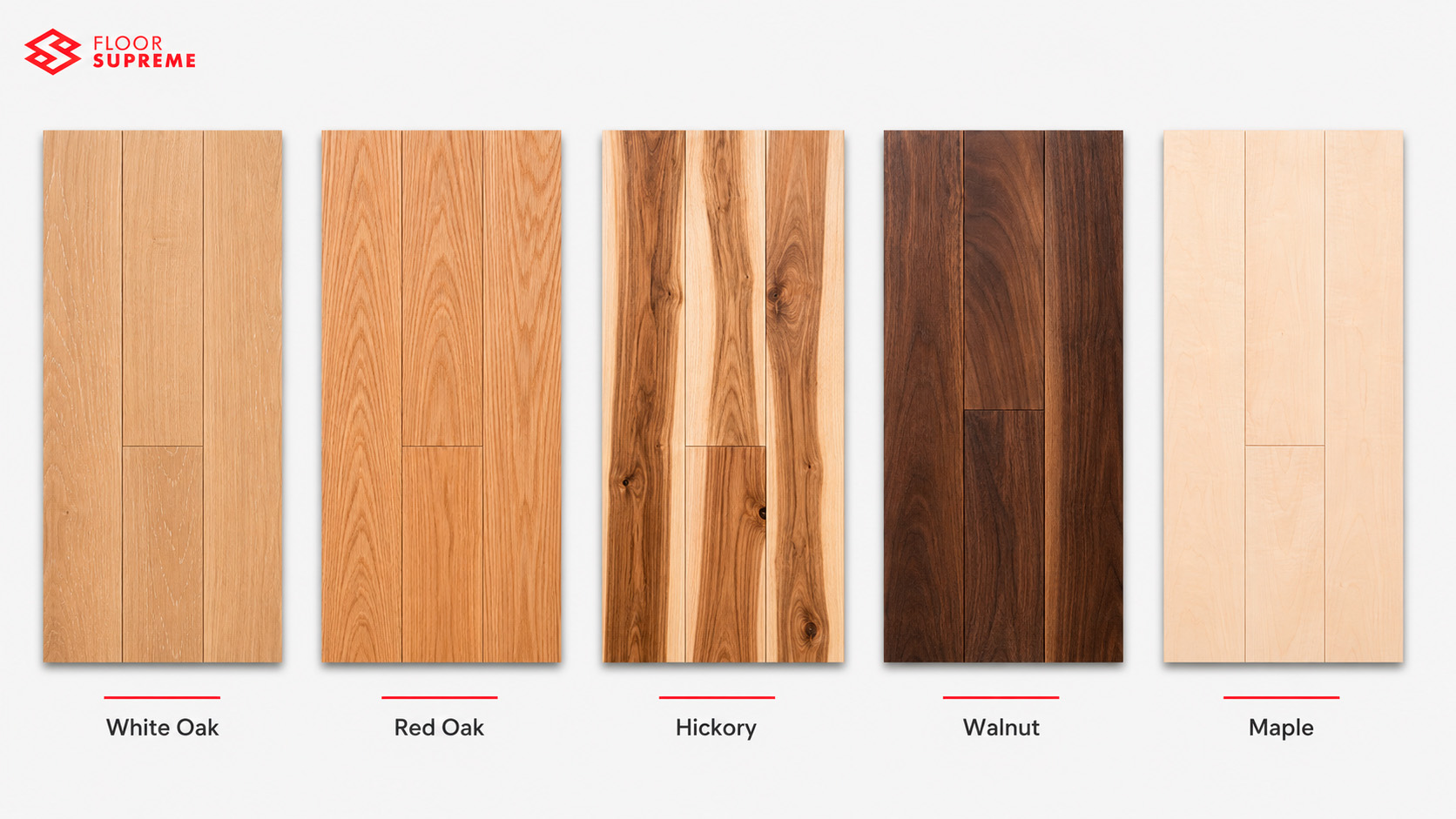
Both solid and engineered hardwood are available in a wide range of wood species. Among Floor Supreme clients throughout Monmouth County and the broader NJ market, the following species are most frequently selected:
White Oak
White oak has become the dominant choice in the NJ residential flooring market for the past several years, driven by its clean, linear grain, its compatibility with both warm and cool stain tones, and its slightly higher Janka hardness (1360) compared to red oak (1290). White oak’s low tannin content makes it particularly compatible with water-based stains, including the popular gray and whitewash tones that characterize contemporary NJ home interiors. Available in both solid and engineered formats in widths from 3 to 7 inches.
Red Oak
Red oak remains the most widely installed hardwood species in existing NJ homes — the majority of original hardwood floors in Monmouth County colonials, split-levels, and ranches built between 1960 and 2000 are red oak. Its slightly pink-red undertone and pronounced grain make it a classic choice for traditional NJ interior aesthetics. For homeowners who already have red oak in the home and are extending or adding hardwood, matching red oak is typically the practical choice to maintain a consistent floor throughout.
Hickory
Hickory is the hardest domestic wood species commonly used in flooring (Janka 1820), making it the best choice for NJ households with heavy traffic, dogs, or active children. Its dramatic color variation and distinctive grain give it a rustic, character-rich aesthetic that appeals to homeowners seeking a floor with visual texture and warmth.
Walnut
Walnut’s rich chocolate tones and fine, straight grain make it a luxury choice for NJ homes seeking a sophisticated, contemporary aesthetic. It is softer than oak or hickory (Janka 1010), making it more susceptible to denting in high-traffic areas — it is best suited for lower-traffic spaces like master bedrooms, home offices, and formal living rooms in NJ homes.
The Floor Supreme Recommendation for NJ Homeowners
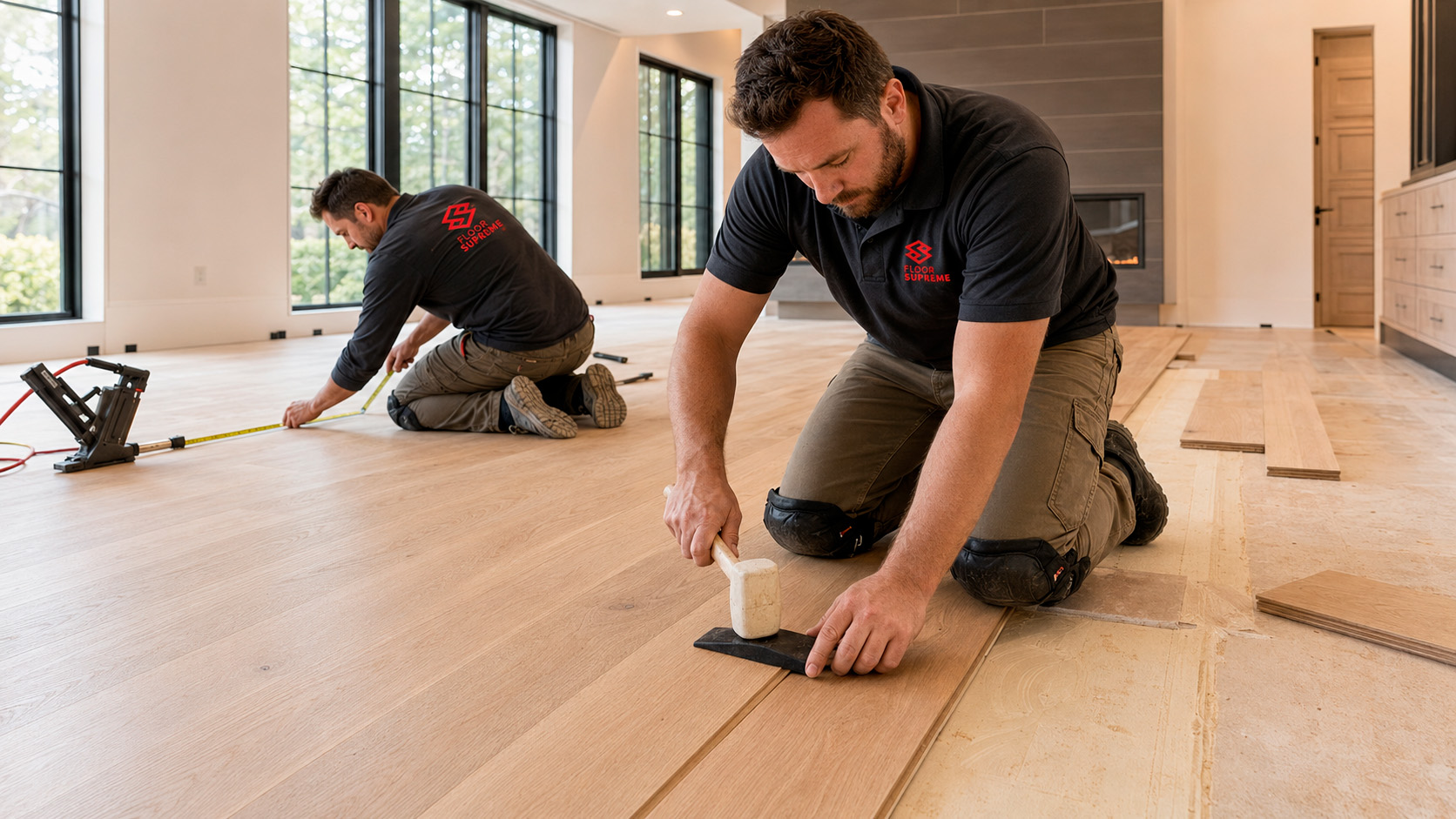
After 15+ years of installing and refinishing hardwood floors across Monmouth County, Ocean County, and Middlesex County, here is the Floor Supreme recommendation for NJ homeowners choosing between solid and engineered hardwood:
Choose solid hardwood if: you are installing in an above-grade space over a wood subfloor, you have or are willing to invest in whole-home humidity control, long-term refinishing potential is a priority, and your budget accommodates the modest premium over engineered at equivalent quality levels. Living rooms, dining rooms, and bedrooms in NJ colonials and split-levels built over wood subfloors are ideal applications for solid hardwood.
Choose engineered hardwood if: you are installing in a kitchen, over a concrete slab, in a below-grade finished basement, or in any space where humidity fluctuation cannot be fully controlled. Also choose engineered hardwood if you want real wood in a NJ home that has radiant heat, or if you are working with a tight project timeline (engineered hardwood typically requires less acclimation time than solid before installation).
When evaluating engineered hardwood, always confirm the wear layer thickness. A product with a 3mm or thicker wear layer can be refinished at least once — preserving the option to restore the floor professionally rather than replace it when it shows wear 10 to 15 years from now. Avoid products with wear layers below 2mm if refinishing potential matters to you.
Frequently Asked Questions — Hardwood vs Engineered Wood in NJ
Can engineered hardwood be refinished?
Yes — but only if the wear layer (top wood veneer) is thick enough to withstand sanding without breaking through to the plywood core beneath. Engineered hardwood with a wear layer of 3mm or thicker can typically be refinished 1 to 2 times. Products with wear layers below 2mm cannot be refinished and must be replaced when worn. Always confirm wear layer thickness before purchasing.
How much does engineered hardwood cost compared to solid in NJ?
In the NJ market in 2026, engineered hardwood typically installs for $7 to $15 per square foot, while solid hardwood installs for $8 to $18 per square foot, with the specific species, width, and grade being the primary cost drivers in both categories. The price gap between equivalent solid and engineered products at the same species and quality level is usually $1 to $3 per square foot installed.
Is engineered hardwood as durable as solid hardwood?
The surface durability of engineered hardwood — scratch resistance, dent resistance, and finish wear — is determined by the species of the top veneer and the finish system applied. A 3mm white oak veneer with a commercial-grade aluminum oxide finish is exactly as durable at the surface as a solid white oak plank with the same finish. The structural durability of solid hardwood over a century of refinishing cycles exceeds engineered hardwood, but for a 20 to 30 year ownership horizon, both products perform comparably in appropriate installation environments.
Can I install hardwood floors in my NJ basement?
Solid hardwood cannot be installed in a NJ basement. Engineered hardwood can be installed in a NJ basement provided the space has controlled moisture levels (consistently below 75% relative humidity) and the installation uses a proper vapor barrier over the concrete slab. Floor Supreme recommends a moisture test before any wood product is specified below grade. Contact us for a free estimate and moisture assessment.
What is the best hardwood flooring for homes with pets and kids in NJ?
For NJ households with dogs, children, or heavy daily traffic, hickory is the hardest and most scratch-resistant domestic hardwood species available. White oak with an aluminum oxide finish is an excellent alternative that balances hardness with contemporary aesthetics. In either solid or engineered format, choosing a harder species and a durable finish system is more impactful for pet-and-kid performance than the solid-versus-engineered distinction itself. Learn more in our Hardwood Flooring Maintenance Tips guide.
Ready to Install Hardwood Floors in Your NJ Home? Start With a Free Estimate.
Floor Supreme has installed and refinished solid and engineered hardwood floors for homeowners throughout Freehold, Howell, Manalapan, Marlboro, Colts Neck, Red Bank, Middletown, Toms River, Edison, and across all of our NJ and NY service areas.
Every project begins with a free, no-obligation in-person estimate and a consultation on material selection specific to your home, your space, and your lifestyle. We will tell you honestly which product — solid or engineered — is the right choice for your specific situation, and we will back that recommendation with a written estimate before any work begins.

1 Comment
Lovie
I’d like to thank you for the efforts you’ve put in penning this website.
I am hoping to see the same high-grade blog posts by you later on as well.
In truth, your creative writing abilities has encouraged
me to get my very own blog now 😉
Here is my web site – bali wedding planner