


Once you’ve decided to refinish your hardwood floors, the next practical question is almost always about timing: how many days will your home be disrupted, when can furniture go back, and when can you actually walk on the floor again? Planning around a refinishing project — especially in an occupied home — requires realistic expectations about the full timeline, not just the sanding itself.
This guide breaks down exactly how long each stage of a hardwood floor refinishing project takes, what affects the timeline, and how to plan around it — whether you’re refinishing a single bedroom in a NJ condo or refinishing an entire main level before hosting a holiday gathering.
Quick Answer: Most Refinishing Projects Take 3 to 5 Days
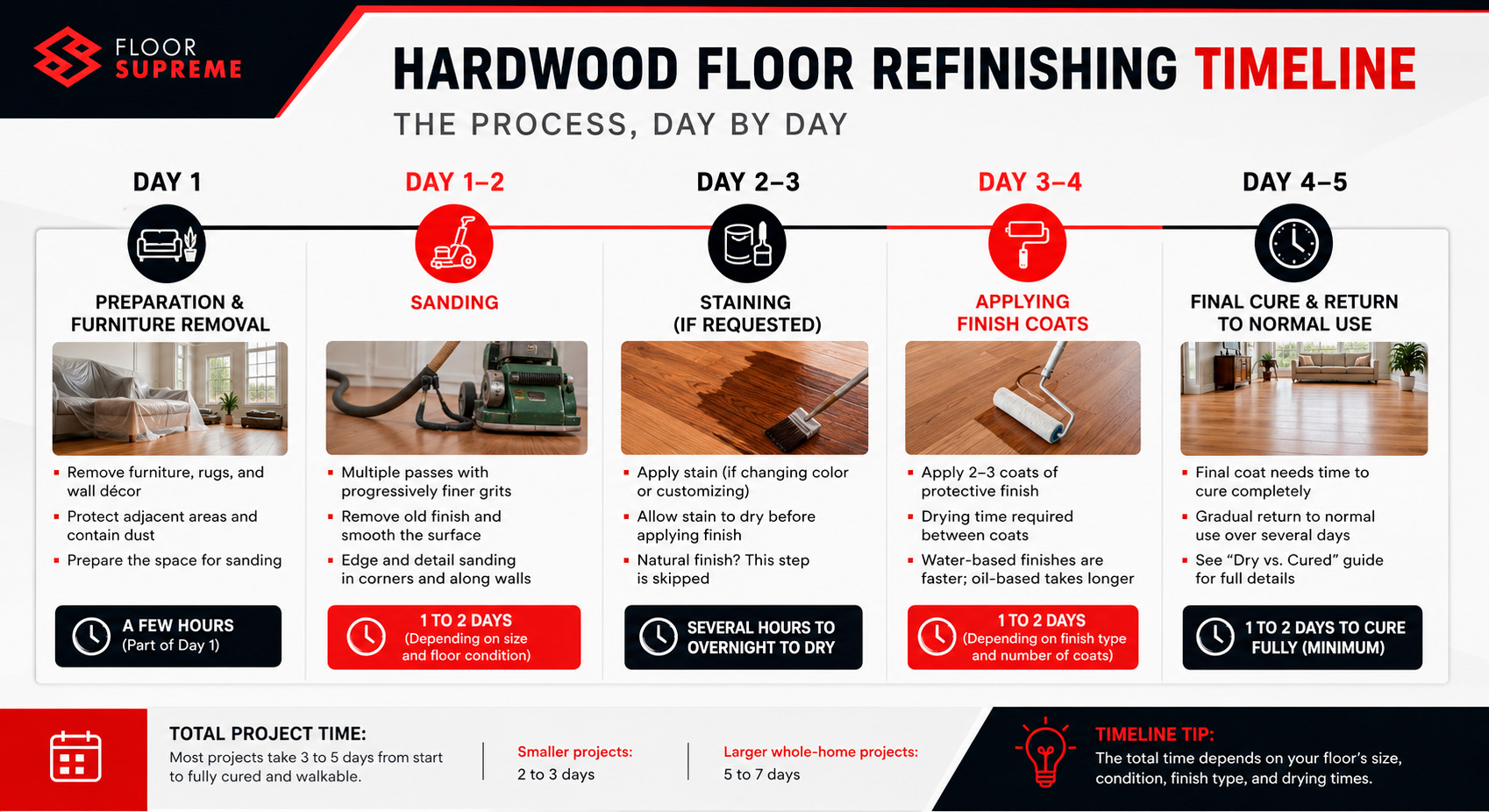
For a typical NJ home, a professional hardwood floor refinishing project — from initial sanding to a fully cured, walkable finish — takes 3 to 5 days for an average-sized area (roughly 500 to 1,000 square feet). Larger whole-home projects can take 5 to 7 days, while smaller single-room projects can sometimes be completed in as little as 2 to 3 days. However, “walkable” and “fully cured” are two different milestones — and understanding that distinction is critical for planning your project around your life.
The Full Refinishing Timeline, Stage by Stage
Day 1: Preparation and Furniture Removal
Before any sanding begins, the work area must be fully cleared of furniture, rugs, curtains near the floor, and any wall décor that could be affected by dust or vibration. Floor Supreme protects adjacent rooms, doorways, and HVAC vents to contain dust migration throughout the home. This preparation typically takes a few hours and, for most residential projects, is completed on the morning of Day 1 before sanding begins that same day.
Day 1–2: Sanding
Sanding is typically the most time-intensive phase, involving multiple passes with progressively finer grit sandpaper to remove the old finish and create a smooth, even surface. For a standard 500 to 800 square foot area, sanding usually takes a full day. Larger projects or floors with significant existing damage — deep scratches, uneven boards, previous refinishing that left an inconsistent surface — may extend sanding into a second day. Detail sanding along edges, corners, and closets is completed during this phase as well, using smaller edging equipment that reaches areas the main sanding machine cannot.
Day 2–3: Staining (If Requested)
If you’re changing the color of your floor or applying a custom stain, this step is added after sanding is complete and the floor has been thoroughly cleaned of dust. Stain application itself typically takes a few hours for an average room, but the floor must then dry before the first finish coat can be applied — usually requiring several hours to overnight, depending on the stain product and ambient humidity. Projects that keep the floor’s natural color skip this step entirely, which is one reason natural-finish refinishing projects are often a day faster than custom-stained ones.
Day 3–4: Applying Finish Coats
Most hardwood refinishing projects apply 2 to 3 coats of protective finish, with drying time required between each coat. This is where finish type makes a real difference in your total project timeline:
- Water-based polyurethane dries to the touch in as little as 2 to 4 hours, and a second coat can often be applied the same day, or the following morning. Full projects using water-based finish frequently complete all coats within 2 days.
- Oil-based polyurethane requires significantly longer between coats — typically 24 hours minimum — meaning a 2-coat oil-based project needs a minimum of 2 full days just for the finishing stage alone, and 3-coat systems can add a third day.
This is one of the most important scheduling decisions in the entire project. If your timeline is tight, water-based finish is the faster option — a detail worth discussing during your estimate if you’re working around a specific deadline like a move-in date or hosted event.
Day 4–5: Final Cure and Return to Normal Use
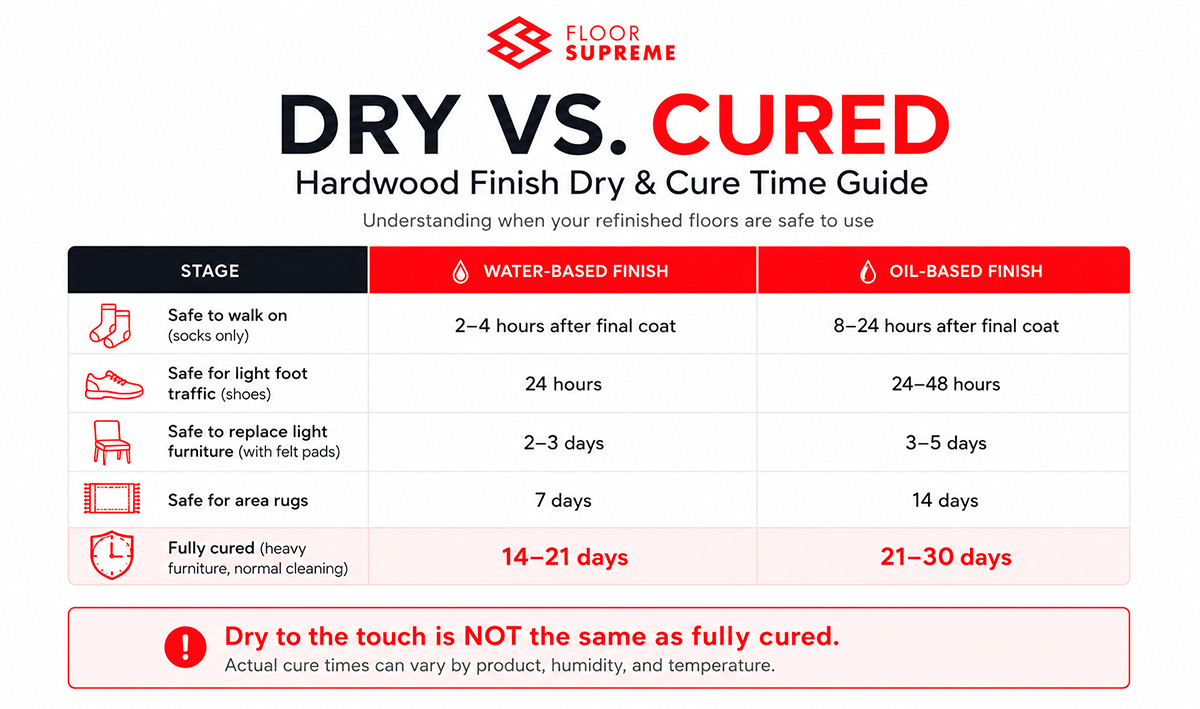
Once the final coat is applied, the floor needs time to cure before furniture, rugs, and normal foot traffic return. This is the stage most homeowners underestimate — “dry to the touch” is not the same as “fully cured and ready for normal use.” See the detailed cure-time breakdown below for exactly what you can and cannot do at each stage.
“Dry” vs “Cured”: Why This Distinction Matters
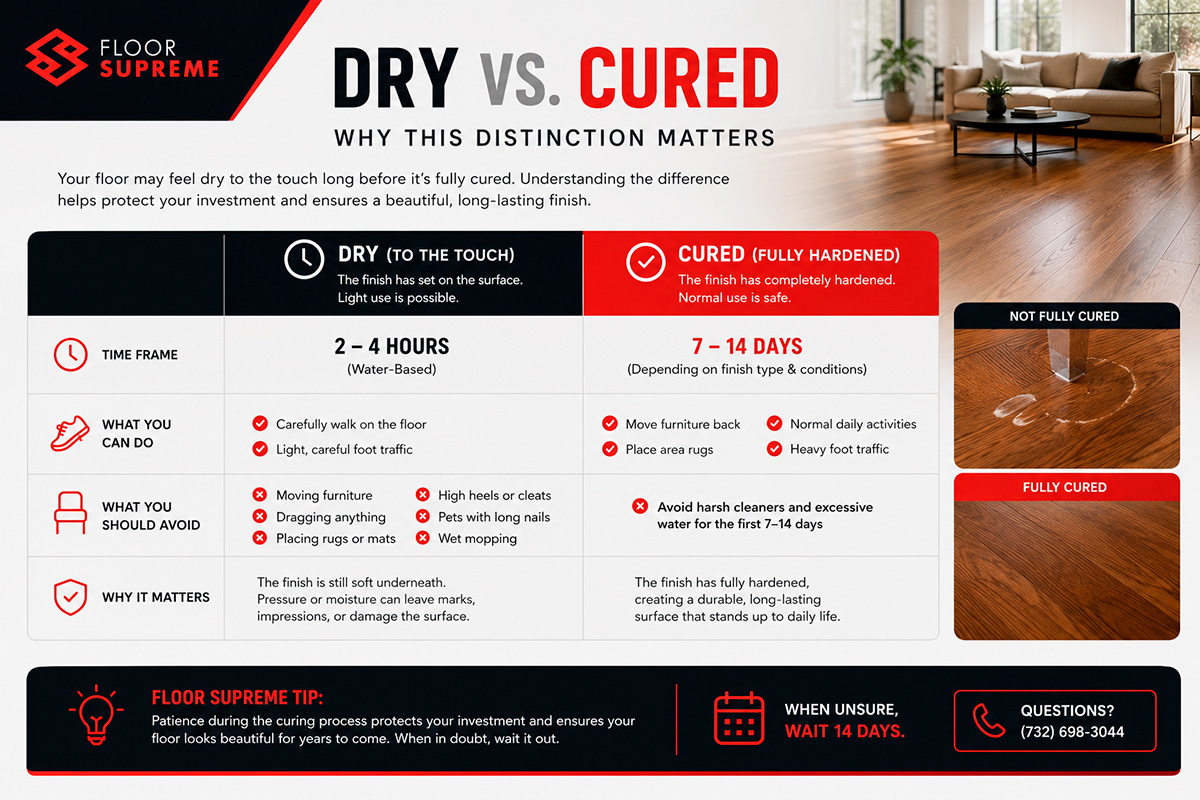
One of the most common sources of confusion for NJ homeowners after a refinishing project is the difference between a finish being “dry” and being fully “cured.” These are two very different states, and treating your floor as fully cured before it actually is can cause dents, imprints, or finish damage that requires touch-up work.
| Stage | Water-Based Finish | Oil-Based Finish |
|---|---|---|
| Safe to walk on (socks only) | 2–4 hours after final coat | 8–24 hours after final coat |
| Safe for light foot traffic (shoes) | 24 hours | 24–48 hours |
| Safe to replace light furniture (with felt pads) | 2–3 days | 3–5 days |
| Safe for area rugs | 7 days | 14 days |
| Fully cured (heavy furniture, normal cleaning) | 14–21 days | 21–30 days |
These figures are general guidelines — always follow the specific care instructions provided by your flooring contractor after your project is complete, since exact cure times vary by product manufacturer and the ambient temperature and humidity conditions in your home at the time of application. Rushing furniture, rugs, or heavy cleaning back onto a floor before it’s fully cured is one of the most common (and preventable) causes of finish damage after a refinishing project.
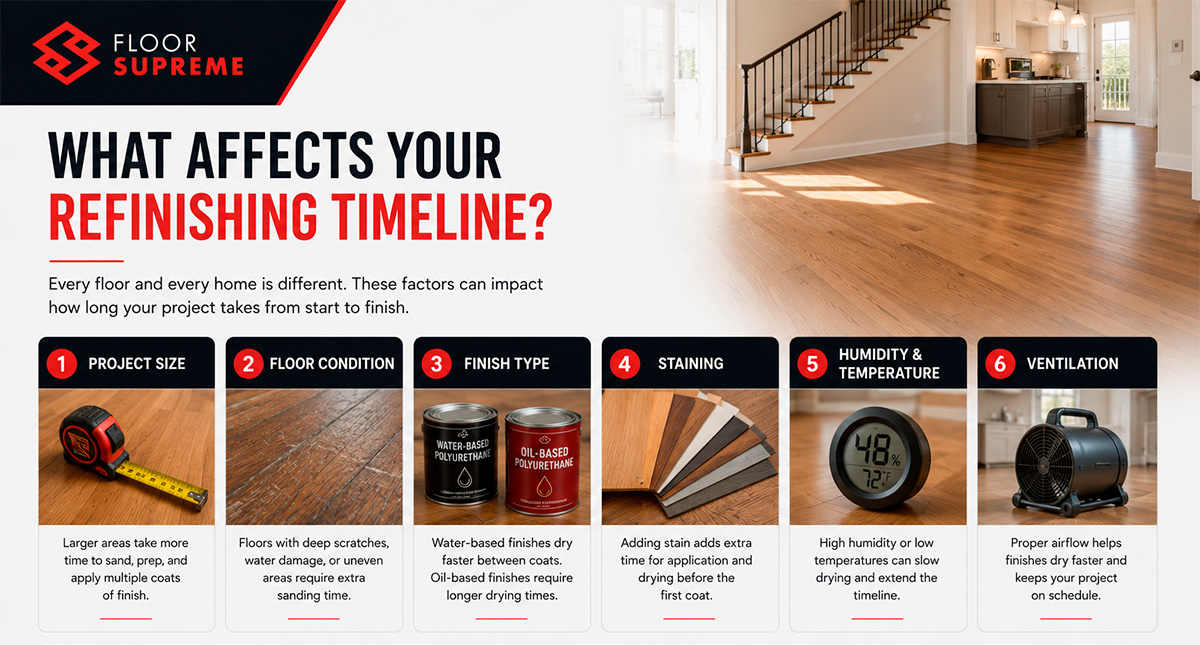
Factors That Affect Your Specific Timeline
1. Total Square Footage
Larger projects naturally take longer for the sanding phase, though the finishing phase (drying between coats) takes the same amount of time regardless of square footage — a 200 square foot bedroom and a 2,000 square foot main level both need the same number of hours for a water-based coat to dry, even though the sanding and application time itself differs significantly. This is why very large whole-home projects don’t scale up linearly in total days — the fixed drying time between coats becomes a smaller proportion of the overall schedule as square footage increases.
2. Finish Type Selected
As covered above, water-based finishes cut significant time off the finishing phase due to faster dry times between coats. If your timeline is a priority — for example, you need to be back in the home by a specific date — water-based finish is almost always the faster path, even though it sometimes carries a modest cost premium over standard oil-based systems.
3. Number of Finish Coats
Most residential refinishing projects use 2 to 3 coats of finish. Each additional coat adds one full drying cycle to the timeline — for oil-based finish, that can mean an extra full day per coat. High-traffic commercial applications sometimes call for additional coats for durability, which extends the project timeline accordingly.
4. Custom Staining
Adding a custom stain color adds at least one additional day to the project — time for stain application and drying before the first finish coat can go on top. Homeowners refinishing to match their floor’s existing natural color skip this step and typically complete their project a day faster than those requesting a color change.
5. Humidity and Temperature in Your Home
Finish drying time is directly affected by ambient humidity and temperature. In NJ’s humid summer months, drying times between coats can run longer than manufacturer-listed averages, especially in homes without air conditioning running during the project. In dry winter conditions with indoor heating, finishes often dry somewhat faster. Floor Supreme adjusts scheduling expectations based on the season and your home’s specific conditions during your estimate.
6. Condition of the Existing Floor
A floor with significant damage — deep scratches, water stains, boards requiring repair or replacement — takes longer in the sanding and prep phase than a floor in typical, moderately worn condition. Board repairs, in particular, can add time if replacement boards need to acclimate to the room’s humidity before installation, which is standard practice to prevent future gapping or warping.
7. Screen-and-Recoat vs Full Refinish
If your floor qualifies for a screen-and-recoat rather than a full sand-and-refinish, your timeline shrinks considerably — often to just 1 to 2 days total, since there’s no full sanding phase and typically only one or two fresh topcoats are applied to the lightly abraded existing finish. Learn more about whether your floor qualifies in our guide: How Often Should You Refinish Hardwood Floors?
Sample Project Timelines
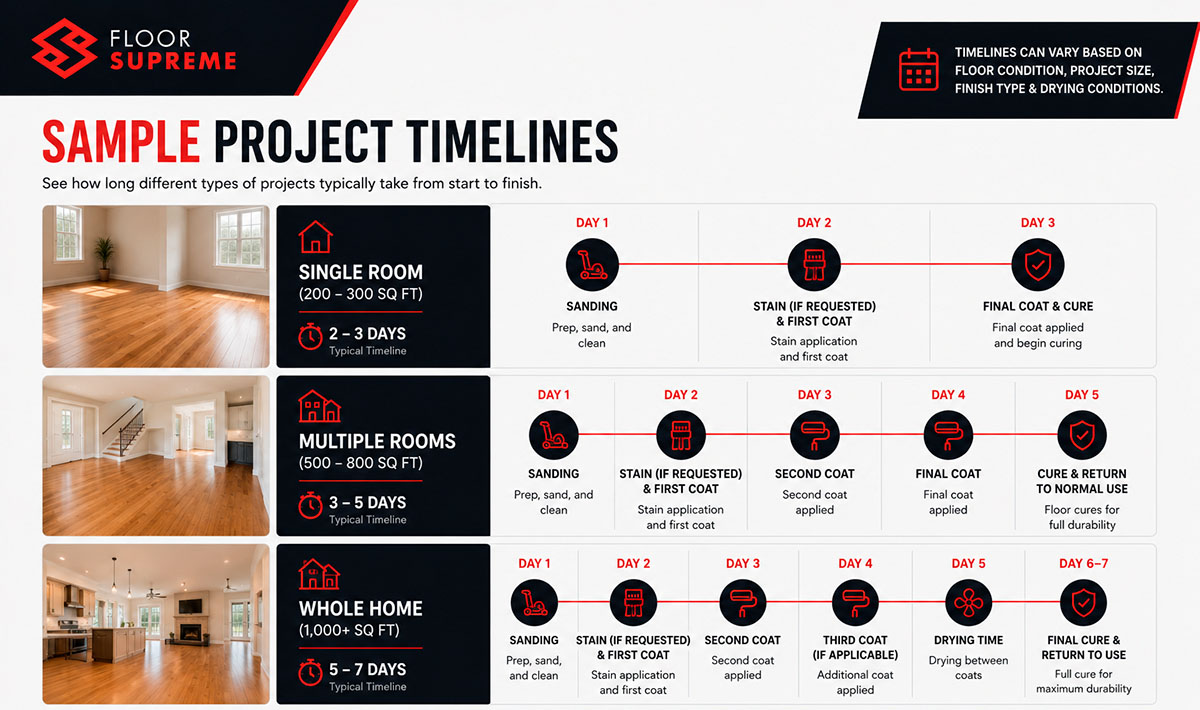
Single Bedroom (~200 sq ft), Natural Finish, Water-Based Polyurethane
Total timeline: 2 to 3 days. Day 1: prep and sanding. Day 2: apply first and second finish coats (water-based dries fast enough to allow same-day recoating in many cases). Day 3: light foot traffic allowed; furniture returns after several more days of curing.
Living + Dining Room Combo (~500 sq ft), Custom Stain, Oil-Based Finish
Total timeline: 4 to 5 days. Day 1: prep and sanding. Day 2: staining and dry time. Day 3–4: first and second finish coats with 24-hour drying between each. Day 5: light foot traffic allowed; full furniture return scheduled for later in the following week as curing continues.
Whole Main Level (~1,500 sq ft), Natural Finish, Water-Based Polyurethane
Total timeline: 4 to 6 days. Day 1–2: prep and sanding (larger square footage extends this phase). Day 3–4: finish coats applied with faster water-based dry times allowing same-day or next-day recoating. Day 5–6: final walkthrough and light foot traffic; furniture and rug return staged over the following two weeks as full cure completes.
How to Plan Your Life Around a Refinishing Project
Because refinished floors need days of foot traffic restriction and one to three weeks of full cure time before heavy furniture returns, planning ahead makes a real difference in how smoothly the project fits into your life:
- Plan to be out of the treated area for the full sanding and staining phase — dust and fumes, even with dustless sanding systems and low-VOC finishes, are easier to avoid entirely during active work.
- Arrange alternate living space for the rooms being refinished — if it’s your only kitchen or bathroom access route, plan an alternate path through the home during the project.
- Have a furniture staging plan. Furniture removed from the work area needs somewhere to go for the full duration — a garage, spare room, or temporary storage.
- Avoid scheduling projects right before major events if a fast turnaround isn’t realistic — refinishing a living room the week of a holiday gathering leaves little room for delays, and rugs typically cannot go back down for at least a week even with fast-curing finishes.
- Ask about pet and family accommodation. Pets should be kept off treated floors during the full curing window; if you have young children or pets that are difficult to manage during a multi-day restriction, plan accordingly.
- Build in a buffer. Weather, humidity, and floor condition can occasionally extend a timeline by a day. If you have a hard deadline, discuss it with your contractor upfront so the schedule includes reasonable buffer time.
How Floor Supreme Minimizes Disruption During Refinishing
Floor Supreme uses professional dustless sanding systems on every NJ refinishing project. This equipment captures the vast majority of sanding dust at the source, meaning less airborne dust throughout your home, faster cleanup, and less time spent settling dust that would otherwise migrate to furniture, HVAC systems, and adjacent rooms during a traditional sanding process. While dustless sanding doesn’t change the underlying finish drying times, it significantly reduces the disruption and post-project cleanup burden compared to older sanding methods.
We also provide a clear, written project timeline before work begins — including specific dates for each phase, expected walkable and cure milestones, and a realistic date for furniture and rug return — so there are no surprises about how the project timeline affects your household.
Frequently Asked Questions — Hardwood Refinishing Timeline
How long does it take to refinish hardwood floors?
Most hardwood floor refinishing projects take 3 to 5 days from start to finish for an average-sized area (500 to 1,000 square feet), including sanding, staining if requested, and applying multiple coats of finish. Smaller single-room projects can sometimes be completed in 2 to 3 days, while larger whole-home projects may take 5 to 7 days.
How long before I can walk on refinished hardwood floors?
With water-based finish, floors are typically safe for sock-only foot traffic within 2 to 4 hours of the final coat, and light shoe traffic within 24 hours. With oil-based finish, this takes longer — typically 8 to 24 hours for sock traffic and 24 to 48 hours for shoe traffic.
How long before I can put furniture back on refinished floors?
Light furniture with felt pads can typically go back after 2 to 3 days with water-based finish, or 3 to 5 days with oil-based finish. Heavy furniture should wait until the finish is fully cured, which takes 14 to 21 days for water-based finish and 21 to 30 days for oil-based finish.
Does water-based or oil-based finish dry faster?
Water-based polyurethane dries significantly faster than oil-based polyurethane. Water-based finish is typically dry to the touch in 2 to 4 hours and can often be recoated the same day, while oil-based finish requires a minimum of 24 hours between coats.
Can I speed up a hardwood refinishing project?
Choosing a water-based finish instead of oil-based, skipping custom staining in favor of the wood’s natural color, and opting for a screen-and-recoat instead of a full refinish (when your floor qualifies) are the most effective ways to reduce your project timeline.
